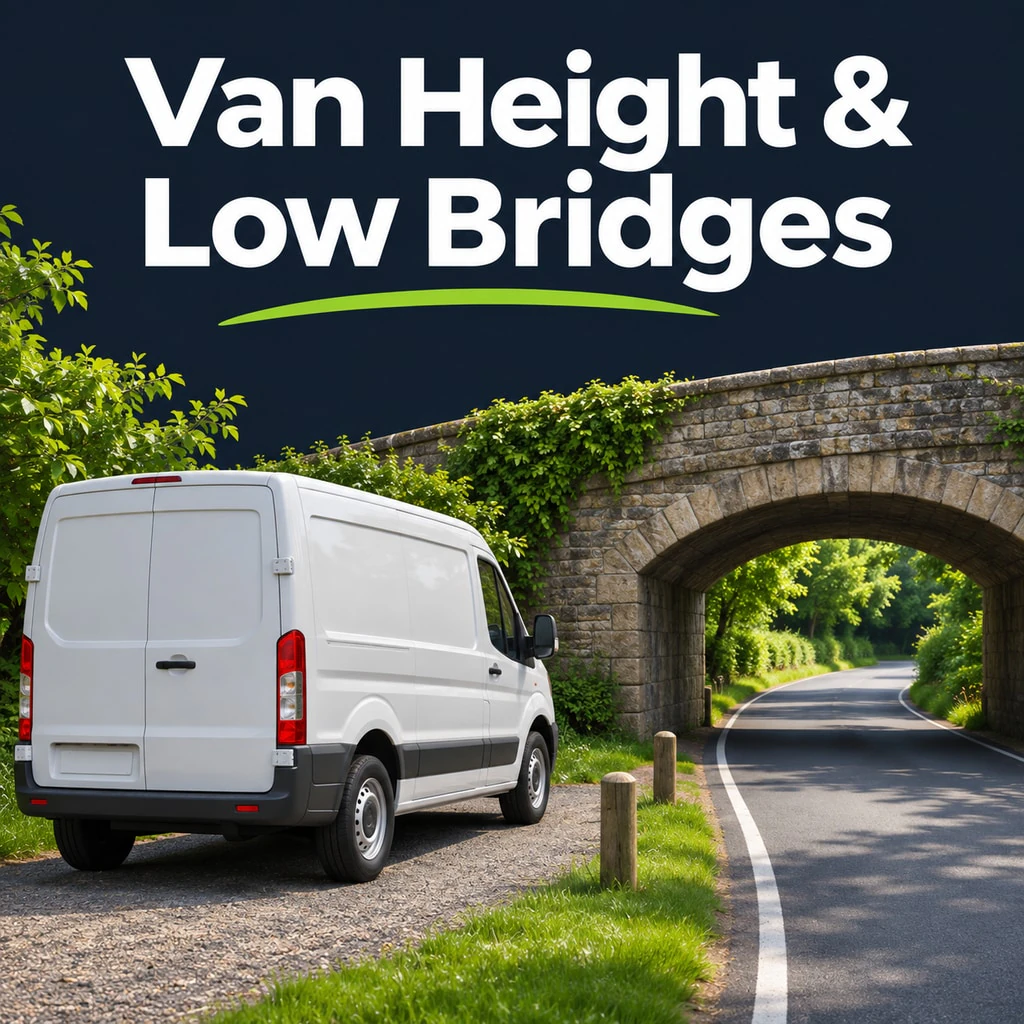
Use the actual van’s external height when checking low bridges, car parks and site entrances. Internal standing room, the rear-door height and the label “high roof” answer different questions. None tells you on its own whether the complete vehicle can pass an overhead restriction.
Before collection, describe the lowest access point on your route. At handover, confirm the allocated vehicle and any fitted roof equipment. If the access cannot be established as safe, choose another route or arrangement before driving towards the restriction.
Which height are you looking at?
| Measurement | What it helps you decide | What it does not prove |
|---|---|---|
| External overall height | Whether the complete vehicle is suitable for a route or entrance. | Do not ignore roof fittings or rely on a different model version. |
| Internal load height | Whether goods or a person can fit inside the load space. | It does not establish clearance under a bridge or barrier. |
| Rear-door opening | Whether a loaded item can pass through the entrance. | It can be smaller than the usable space farther inside. |
| Posted restriction | The limit or clearance shown for that location. | It is not permission to guess at an unknown vehicle height. |
| Site information | The intended entrance, delivery route and unloading area. | A main gate description may omit a lower canopy or internal barrier. |
Start with QVH’s van-size guide if you are choosing a body type. Then verify the exact vehicle, rather than borrowing a dimension from a photograph or another vehicle in the same category.
Check the route before the keys change hands
Network Rail’s bridge-strike prevention advice stresses knowing the vehicle height and planning an appropriate route. A familiar car journey can be unsuitable in a taller van.
Review the route to each stop, including diversions and the return to the depot. A navigation app is an aid, not confirmation of clearance. If a routing system accepts vehicle dimensions, enter the verified details and still observe road signs and conditions.
Avoid treating an estimated conversion between feet and metres as a working clearance. Record the confirmed height clearly for the driver. Do not plan to squeeze through a marginal restriction or invent a standard clearance margin that applies to every site.
Ask the destination about the final approach
| Location | Question for the site | Useful action |
|---|---|---|
| Car park or storage facility | Which entrance accepts this vehicle, and what restrictions apply? | Arrange an approved surface-level loading point if required. |
| Loading bay | Is there a canopy, shutter or overhead service on the approach? | Obtain the usable access information, not just the bay address. |
| Building or yard | Are there low branches, signs, cables or internal barriers? | Agree a safe route and contact person before arrival. |
| Road diversion | Does the alternative route introduce a low bridge? | Review a suitable alternative before committing to it. |
| Collection and return | Is the driver using a different route in the van from the journey to the depot? | Plan the van journey separately from the car journey. |
Example: the goods fit, but the entrance does not
You choose a tall van because a large cabinet needs internal height. The storage operator then confirms that the usual customer route passes beneath a low barrier. The cabinet fitting inside the van does not solve the access problem.
Ask the site about an authorised loading area outside the restricted route and check the handling distance. If there is no suitable arrangement, change the vehicle or destination plan. Do not turn up hoping the barrier will be open or that deflating tyres will make an unsuitable vehicle fit.
If a restriction is unexpected, stop before it
Do not continue towards a bridge or entrance when clearance is uncertain. Stop in a safe, lawful position before the restriction and seek an alternative. Avoid sudden braking or reversing into traffic. A passenger watching the roof does not turn an unknown clearance into a safe one.
If a railway bridge is struck, report it immediately using the details on its identification plate and follow emergency instructions; do not assume that a small mark means the railway is safe. Network Rail explains why bridge strikes require assessment. Call 999 where there is immediate danger, then inform the hire provider once safe.
Choose the vehicle around the whole job
Compare small vans and large vans against the goods and access together. A lower vehicle might need more trips; a taller one might need a different unloading point. Confirm payload and mileage as well as height.
For a move, check both addresses before booking. For business work, keep the verified vehicle details and site restrictions with the job information so a replacement driver does not have to reconstruct the route from memory.
Frequently asked questions
No. A bridge or entrance needs the complete external vehicle height, including relevant fitted equipment. Internal load height describes the space for goods.
No. Body and roof versions, model generations and fittings can differ. Confirm the vehicle actually allocated to the hire.
Do not rely on that. Plan using verified vehicle details, suitable route information and road signs. A familiar car route may not suit a van.
A spotter does not replace verified clearance or make an unsuitable route safe. If the height or access is uncertain, arrange another route or loading point.
Provide the site’s confirmed restriction, the intended entrance, the goods dimensions and any alternative loading arrangement. Resolve compatibility before collecting the van.