

Best Van for Courier Work: How to Choose the Right Size for Multi-Drop Routes
For courier work, the best van is rarely the biggest van you can drive. The right choice is the vehicle that carries a normal day’s workload without making every stop harder than it needs to be. A smaller van can be quicker to park and easier on narrow residential streets, while a larger van can reduce reloads when parcel volume, cages or bulky consignments are the limiting factor.
The most useful way to choose is to look at your real route: how many drops you make, what you carry, how often you need side-door access, how far you drive, where you park and whether your load normally fills the van by volume before it reaches its payload limit.
Need a vehicle for paid delivery work now? This guide is about choosing the right van. For availability, terms and a quote, go directly to our courier van hire service. Vehicles are collected from our Halifax base at HX3 7TG; we do not deliver hire vehicles.
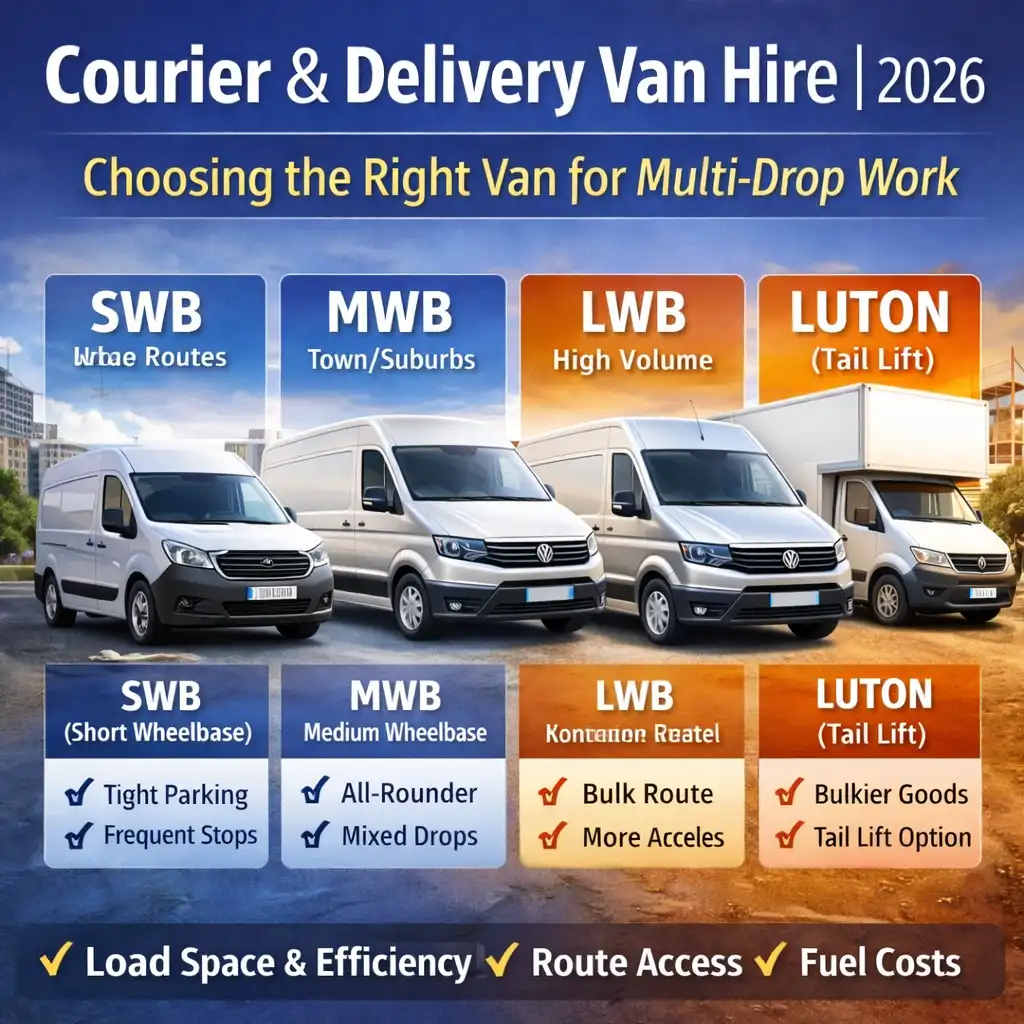
| Van size | Usually best for | Main advantage | Watch for |
|---|---|---|---|
| Small / SWB | Local parcels, frequent residential drops, town and city routes | Easy parking, access and manoeuvrability | Can fill quickly on high-volume days |
| MWB | Mixed routes, growing parcel volume, cages and medium-size consignments | Useful balance of load space and everyday usability | More van than some dense urban routes need |
| LWB | High-volume parcel work, larger consignments and routes where reloads cost time | More usable cargo volume | Parking, turning space and height restrictions |
| Luton / tail lift | Bulky goods, organised loads, fewer larger drops and some pallet or cage movements | Square load area and easier handling of suitable heavy items with a tail lift | Usually less convenient for very frequent tight-access stops |
1. Small and SWB Vans: Best for Frequent Stops and Tight Access
A small or short-wheelbase van is often the most efficient choice when the route matters more than maximum load volume. They are easier to position on residential streets, fit more parking spaces and generally make repeated side-road or town-centre stops less awkward.
For parcel work, a small van makes sense when the load is relatively light and compact, you return to a depot between runs, or you value fast access more than carrying every possible parcel in one load. The trade-off is simple: once daily volume regularly exceeds the usable cargo space, moving up a size can save more time than the smaller van saves at each stop.
2. MWB Vans: The Practical All-Rounder for Mixed Courier Routes
A medium-wheelbase van is a strong all-round option for couriers whose work mixes residential drops, business deliveries and larger parcels. You gain noticeably more load space than a small van without moving straight to the footprint of a full-size LWB vehicle.
MWB vans are particularly useful when your daily workload varies. There is room to organise parcels or cages more effectively, yet the vehicle remains manageable for regular road use. For many owner-drivers and small delivery businesses, that balance matters more than outright capacity.
3. LWB Vans: Better When Load Volume Is Costing You Time
A long-wheelbase van becomes the better choice when you are repeatedly running out of space, returning to reload, leaving work behind or carrying larger consignments. More cargo volume can improve route efficiency if the extra capacity is genuinely used.
The key question is whether that extra space saves more time than the larger vehicle costs you in access and parking. LWB vans are well suited to regional routes, business-to-business deliveries, higher parcel counts and runs where stops are less tightly packed. On dense residential routes, a smaller van may still complete the same workload faster if it can be parked and accessed more easily.
4. Luton Vans and Tail Lifts: Best for Bulky or Organised Loads
A Luton is a different tool rather than simply the next size up. The box-shaped body gives a useful, square cargo area that can be easier to organise for bulky consignments. Tail-lift models can also make loading suitable heavy items, cages or equipment much easier where manual lifting would be impractical.
For high-frequency parcel drops on narrow streets, however, a Luton can be more cumbersome than an SWB, MWB or LWB panel van. If you mainly carry bulky goods or make fewer, larger drops, see our specialist van options and the tail-lift van guide.
What Matters Most When Choosing a Courier Van?
- Usable load space: Think about the shape and organisation of the load, not just quoted cargo volume. You need to reach the next parcel without unloading half the van.
- Payload: Large-looking cargo space does not mean unlimited carrying weight. Check the vehicle’s permitted payload for the goods you expect to move.
- Side and rear access: Frequent multi-drop work can make door position and opening width more important than a small difference in total capacity.
- Parking and turning space: The more stops you make, the more often vehicle length and turning circle affect your day.
- Vehicle height: Larger panel vans and Lutons need more care around height restrictions, car parks and low access points.
- Mileage: Regional and same-day courier work can accumulate mileage quickly, so compare the mileage allowance or package before committing to a vehicle arrangement.
- Driver comfort: Seat comfort, visibility, cab storage and an easy driving position matter when the vehicle is your workplace for most of the day.
- Reliability and support: Lost working time can cost more than a small saving on the vehicle itself. Maintenance and breakdown support matter for business-critical delivery work.
Load Volume vs Payload: Do Not Treat Them as the Same Thing
Courier drivers often fill a van by volume before they reach its maximum payload because parcels can be relatively light but bulky. Other delivery work can do the opposite: dense goods, tools, beverages or equipment may reach the vehicle’s weight limit before the cargo area looks full.
That is why choosing from a photo or vehicle length alone is risky. If you are unsure, note the typical number and size of parcels, cages or bulky items you carry and compare that with the manufacturer’s load dimensions and payload for the exact vehicle. Our broader van size guide explains the main SWB, MWB, LWB and Luton categories in more detail.
Mileage and Running Costs for Courier Work
A courier vehicle can cover far more miles than a van used for occasional removals or local trade work. Fuel or charging cost therefore matters, but it should not be considered in isolation. A smaller van that requires an additional depot run may cost more overall than a slightly larger van that completes the route in one load.
Before choosing a vehicle, estimate realistic weekly mileage rather than relying on a best-case daily figure. Include travel to the first drop, returns to the depot, failed deliveries, collections and repositioning between delivery areas. If mileage is likely to be high, our unlimited mileage van hire guide explains what to check when comparing mileage arrangements.
Insurance and Paid Courier Work
Paid parcel and delivery work can have different insurance requirements from ordinary private or general business driving. Do not assume that standard cover automatically includes courier or hire-and-reward use. Be clear about the work you will be doing when arranging the vehicle and make sure the insurance applicable to your operation matches that use.
For a general explanation of rental insurance terminology, deposits and excess, see our van hire insurance and excess guide.
Short-Term Vehicle Cover vs a Longer-Term Arrangement
The right commitment depends on how certain the work is. A flexible short-term arrangement can make sense when you are testing a new delivery contract, covering seasonal demand or replacing a vehicle temporarily. See our short-term van rental information for the wider service.
If the route and workload are established, a longer-term arrangement can make budgeting and vehicle planning easier. Businesses with stable ongoing requirements can compare long-term van hire and leasing, while operators adding several vehicles can review fleet van hire and fleet servicing and maintenance.
A Simple Courier Van Selection Checklist
- How many drops do you make on a normal day?
- Are most stops residential, town-centre, industrial-estate or motorway-based?
- Do you normally fill the van by volume or by weight first?
- Do you use loose parcels, shelving, sacks, cages or pallets?
- How important is side-door access on the route?
- Would one larger load remove a reload or second trip?
- Are there regular height, width or parking restrictions?
- What is your realistic weekly mileage including depot and return journeys?
- Will the vehicle be used for paid courier or delivery work?
If you can answer those questions, choosing between SWB, MWB, LWB and Luton becomes much easier. If you need a vehicle rather than more general guidance, view our courier van hire options or call 01422 361 436 to discuss your route, load and expected mileage.
Best Van for Courier Work FAQs
Common questions about choosing SWB, MWB, LWB and Luton vans for parcel and multi-drop delivery routes.
For frequent urban and residential drops, a small or SWB van is often the easiest to park and manoeuvre. MWB vans suit mixed routes and higher parcel volumes, while LWB vans work well when additional cargo space avoids reloads. Lutons are usually better for bulky loads or fewer, larger deliveries.
Often, yes. An SWB van can be a very efficient choice when parcels are relatively compact and stops are frequent. If the van regularly fills before the route is complete, an MWB may save more time by reducing reloads while remaining manageable in town and residential areas.
Choose MWB when you need more room than a small van but still make frequent stops where parking and manoeuvrability matter. Choose LWB when higher load volume is the bigger constraint and the route normally has enough space for a longer vehicle.
They can be, particularly for bulky consignments, organised loads and fewer high-volume drops. For very frequent stops on narrow streets, a panel van is often easier to use. Tail lifts are useful where suitable heavier items or cages need mechanical loading assistance.
It depends on what you carry. Parcel routes often run out of cargo volume before they reach the weight limit, while dense goods can reach payload first. Check both the usable load dimensions and permitted payload for the exact vehicle rather than choosing by body size alone.
Check your typical parcel volume, payload, number of drops, route access, side and rear door requirements, vehicle height, weekly mileage and whether a larger vehicle would remove reloads. For paid courier work, also make sure the insurance and vehicle agreement are suitable for the intended use.